
Best Nilfisk Vacuums in 2026: 6 Picks Compared on Specs
For most homes and workshops, the Nilfisk Alto Aero 31-21 INOX is our top pick. It is a wet/dry vacuum with a HEPA filter, useful for both liquid spills and fine dust. We chose it because it balances the versatility of wet/dry design with a filtration level that the EPA says captures at least 99.97% of particles at 0.3 microns. This guide compares all six Nilfisk vacuums available, judged only on stated specifications and the maker's published information. Prices are live from each listing.
6 picks from 1 vacuums that match this guide with a price we can quote today. The prices below are current and each carries its read time.
Quick picks
The best fit for you
- For workshop owners: You need a wet/dry vacuum that can handle sawdust and liquid spills without clogging. See pick 2
- For allergy sufferers: You want HEPA filtration in a vacuum that also picks up wet messes. See pick 4
- For cleanrooms and labs: You need ULPA filtration for critical areas where even HEPA is not enough. See pick 5
- For home floor cleaning: You prefer a canister vacuum for hard floors and carpets. See pick 3
Our 6 picks
1 Best overall

This is the only wet/dry vacuum in the list that combines an 8-gallon tank with a HEPA filter, so it can handle both liquid spills and fine dust that would otherwise pass through a standard filter. Compared with the 19-gallon contractor model, it is more compact and includes a filtration upgrade, while still covering the basic wet/dry role. It is the most versatile choice for a home workshop where occasional fine dust matters.
Pros
- 8-gallon capacity, the second largest in this list
- HEPA filter per EPA's definition of high-efficiency particulate air
- Wet/dry design for spills and dry debris
- Stainless steel (INOX) tank as stated in the name
Cons
- Smaller tank than the 19-gallon contractor model
- No auto filter cleaning feature
- No ULPA filtration for critical environments
Good fit if
- Home workshops that need one vacuum for wet and dry
- Users who want HEPA filtration without moving to a critical-area model
Skip if
- Contractors who need maximum capacity and self-cleaning filters
- Users who need ULPA filtration for sensitive environments
Verdict: The best all-around Nilfisk for most mixed-use situations.
2 Best heavy-duty capacity

With a 19-gallon tank, this is the largest-capacity Nilfisk in the list, and it adds a tool-start outlet and an auto filter cleaning system that the other models lack. If you are a contractor or work with heavy debris, this machine can run longer between empties and keep the filter clear without manual attention. Its trade-off is that the listing does not mention HEPA or ULPA filtration, so it is not aimed at fine dust capture.
Pros
- 19-gallon tank, the largest of the six
- Tool-start outlet for powering a tool while vacuuming
- Auto filter cleaning system
- Contractor-grade construction
Cons
- No HEPA or ULPA filter mentioned
- Larger and likely heavier, though weight is not stated
- May be overkill for small spaces
Good fit if
- Construction sites and heavy renovation work
- Users who only want to empty the tank occasionally
Skip if
- Home users needing HEPA filtration
- People with limited storage space
Verdict: The workhorse Nilfisk for big jobs, with a large tank and self-maintaining filter.
3 Best canister vacuum
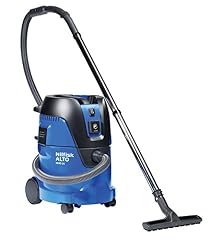
This is the only canister-style Nilfisk in the list, meaning the motor and filter are in a separate unit from the hose, which can make it easier to maneuver under furniture. It is a straightforward dry vacuum without a wet pickup function, so it suits daily home cleaning on hard floors and carpets. The listing does not state a tank capacity or filtration type, so we can only compare it on its form factor.
Pros
- Canister design, the only one in this list
- Suitable for dry surfaces like floors and carpets
- Easy hose handling for above-floor cleaning
Cons
- No wet pickup capability
- Tank capacity not stated by the seller
- No HEPA or ULPA filter mentioned
Good fit if
- Homeowners who prefer a canister layout
- Users cleaning mostly dry floors and upholstery
Skip if
- Anyone needing wet/dry capability
- Users who want a large tank or fine filtration
Verdict: A no-frills canister Nilfisk for everyday dry cleaning.
4 Best HEPA wet/dry

Eliminator Pro II Wet/Dry HEPA Vacuum
- Type
- Wet-dry
$1,470.99 price as of 2026-10-03 05:34 UTC (Details)
This model explicitly pairs wet/dry capability with a HEPA filter, something only two vacuums in this list claim. Unlike the Alto Aero 31-21, which also has both, the Eliminator Pro II carries the 'Pro' designation in its name, suggesting it is built for more frequent professional use. However, the listing does not state tank capacity, so it is harder to judge capacity against the others.
Pros
- HEPA filter as defined by the EPA
- Wet/dry function for spills and dust
- Professional-sounding 'Pro' designation (not a spec)
Cons
- Tank capacity not stated by the seller
- No tool-start or auto filter cleaning
- Only one filter type mentioned
Good fit if
- Professionals who need fine filtration in a wet/dry unit
- Users with allergy concerns but also wet messes
Skip if
- Those who need a large tank
- Users who prefer a canister form
Verdict: A HEPA-equipped wet/dry vacuum for users who prioritize filtration.
5 Best for critical areas

This vacuum is designed for critical areas, with ULPA filtration that goes beyond HEPA, and a stainless steel tank that can handle harsher materials. Its 3.25-gallon tank is the smallest here, and it is not described as wet/dry, so it is meant for specialized dry cleanup in labs or cleanrooms. The 1.5 hp peak power is stated, which gives a sense of suction capability.
Pros
- ULPA filter, which exceeds HEPA efficiency
- Stainless steel tank
- 3.25-gallon capacity stated
- 1.5 hp peak power stated
Cons
- Smallest tank in this list
- No wet pickup mentioned
- No additional features like tool start
Good fit if
- Laboratories, cleanrooms, and electronics manufacturing
- Users needing maximum particle capture
Skip if
- General home or workshop use where you want large capacity
- Jobs that require wet pickup
Verdict: The specialized choice for environments where particle control is critical.
6 Best basic wet/dry

The Attix 30-21 PC is listed under the Nilfisk Attix series and the product name includes 'eau et poussière', which indicates wet and dust pickup. It is the only model in the list where the seller provides almost no specifications: no capacity, no filter type, and no extra features. As such, it serves as a simple wet/dry vacuum for users who do not need the advanced filtration or capacity of the other picks.
Pros
- Wet/dry capability indicated by the product name
- Part of the established Nilfisk Attix line
- No extra features to complicate use
Cons
- No tank capacity stated by the seller
- No filter type (HEPA or ULPA) mentioned
- No tool-start or other features listed
Good fit if
- Users who want a basic wet/dry vacuum without bells and whistles
- Budget-conscious buyers who only need simple pickup
Skip if
- Anyone who needs HEPA or ULPA filtration
- Users who require a large tank or power tool activation
Verdict: A straightforward wet/dry vacuum, though with limited listed specifications.
Specifications side by side
| # | Vacuum | Type | Power | Dust collection | Suction | Pet hair | Mopping |
|---|---|---|---|---|---|---|---|
| 1 | Nilfisk Alto Aero 31-21 INOX 8-Gallon Wet/Dry Vacuum | Wet-dry | not stated | not stated | not stated | not stated | not stated |
| 2 | Nilfisk 19 Gal. Contractor-Grade Wet/Dry Vac | Wet-dry | not stated | not stated | not stated | not stated | not stated |
| 3 | Nilfisk-Alto AERO 26-21 PC | Canister | not stated | not stated | not stated | not stated | not stated |
| 4 | Eliminator Pro II Wet/Dry HEPA Vacuum | Wet-dry | not stated | not stated | not stated | not stated | not stated |
| 5 | Nilfisk - L01798070 Critical Area Vacuum | not stated | not stated | not stated | not stated | not stated | not stated |
| 6 | Nilfisk Attix 30-21 PC Aspirateur eau et poussière | not stated | not stated | not stated | not stated | not stated | not stated |
How the picks were chosen
The pool for this guide contains six Nilfisk vacuums found in the catalog, and we included every one of them rather than shortlisting further, because the brand lineup is small and each model serves a distinct role. We compared them on the specifications the seller provides: vacuum type (wet/dry or canister), tank capacity where stated, filtration claims such as HEPA or ULPA, and extra features such as a tool-start outlet or auto filter cleaning. We did not run performance tests, nor did we rely on customer reviews; all descriptions come from the product listings themselves. Prices on this page are live, read from the store at the time the page loads, so figures you see here may change. Where a specification is missing from the listing, we say so rather than guessing.
Picking the right one for you
Understand the vacuum type: wet/dry vs canister
Nilfisk offers both wet/dry shop vacuums and canister designs. Wet/dry models have separate compartments for liquid and dry debris, making them suitable for workshops and spills. Canister vacuums, like the AERO 26-21 PC, are typically lighter to push along floors and easier to maneuver around furniture, but they cannot pick up liquids. Choose based on the surfaces you clean and whether you regularly deal with wet messes.
Filtration: HEPA and ULPA explained
The EPA defines a HEPA filter as one that removes at least 99.97% of particles at 0.3 micrometers, the most penetrating particle size. Higher-efficiency ULPA filters capture even smaller particles. If you are vacuuming drywall dust, soot, or other fine particulates, a HEPA or ULPA filter prevents them from being exhausted back into the air. The Nilfisk Alto Aero 31-21 and Eliminator Pro II carry HEPA claims, while the Critical Area Vacuum uses ULPA.
Tank capacity and how often you will empty it
Capacity determines how much debris or liquid you can pick up before emptying the tank. The contractor model in this list has a 19-gallon tank, which is the largest available. In contrast, the Critical Area Vacuum holds only 3.25 gallons, trading capacity for portability and finer filtration. Consider how long you want to run between emptyings and whether space allows for a larger unit.
Matching the vacuum to your environment
Think about the particles you will encounter. A workshop with sawdust calls for a wet/dry vacuum with a large tank and possibly a HEPA filter to keep fine dust down. A laboratory or electronics bench needs the critical-area model with ULPA. A home with carpet and hard floors might prefer the canister vacuum for daily use. Match filtration level and capacity to the dirt you actually produce.
What to do when specs are missing
The catalog sometimes does not list every specification. For example, the Attix 30-21 PC lists no capacity or filter type. In those cases, rely on the product name and the maker's reputation, but know that you cannot confirm key details without contacting the seller or checking the official Nilfisk documentation. When a spec is absent, we mark it as 'not stated' rather than guessing.
Questions
What does HEPA stand for and what does it do?
HEPA stands for High-Efficiency Particulate Air. According to the U.S. EPA, a HEPA filter can theoretically remove at least 99.97% of airborne particles with a size of 0.3 micrometers, which is the most penetrating particle size. Using a vacuum with a HEPA filter can help keep fine dust from being exhausted into the air you breathe.
Are Nilfisk vacuums suitable for wet pickup?
It depends on the model. Nilfisk wet/dry vacuums, such as the Alto Aero 31-21 and the contractor-grade 19-gallon model, are designed to handle both liquid spills and dry debris. The canister vacuum in this list is not stated to pick up wet material, so it should only be used on dry surfaces.
What is the difference between HEPA and ULPA?
HEPA filters capture at least 99.97% of particles at 0.3 microns. ULPA (Ultra-Low Penetration Air) filters are even more efficient, removing particles at a smaller size, often down to 0.12 microns, with a minimum efficiency of 99.999%. ULPA is typically used in critical environments like cleanrooms.
How do I know which Nilfisk vacuum is right for me?
Start by identifying your primary surface and debris type. For wet spills and dry workshop dust, choose a wet/dry model. If you need meticulous filtration for allergens or fine powders, look for HEPA or ULPA. Consider tank capacity based on how often you want to empty it, and always check the stated specifications because some models omit details.
Can I use these vacuums with power tools?
Only the 19-gallon contractor-grade model in this list is stated to have a tool-start outlet, which lets the vacuum turn on automatically when you switch on a connected power tool. Other models in the list do not mention this feature, so you would need to turn the vacuum on manually if you use it for dust extraction.
Revision notes
- : First published.